Today's rail plan by Labour is a landmark moment.
from Political News - International and UK Politics | Sky News https://ift.tt/vNal051
Thursday, April 25, 2024
Wednesday, April 24, 2024
Labour promises publicly owned rail - as Tories slam 'unfunded nationalisation'
Labour will promise to deliver the biggest shake-up to rail "in a generation" by establishing the long-delayed Great British Railways (GBR) organisation and bringing routes back into public ownership.
from Political News - International and UK Politics | Sky News https://ift.tt/pYRtBET
from Political News - International and UK Politics | Sky News https://ift.tt/pYRtBET
Rishi Sunak's 'big announcements' establish 'dividing line' with Labour and put pressure on Europe to step up - analysis by Katherine Forster
“We will do whatever it takes to keep our countries safe”.
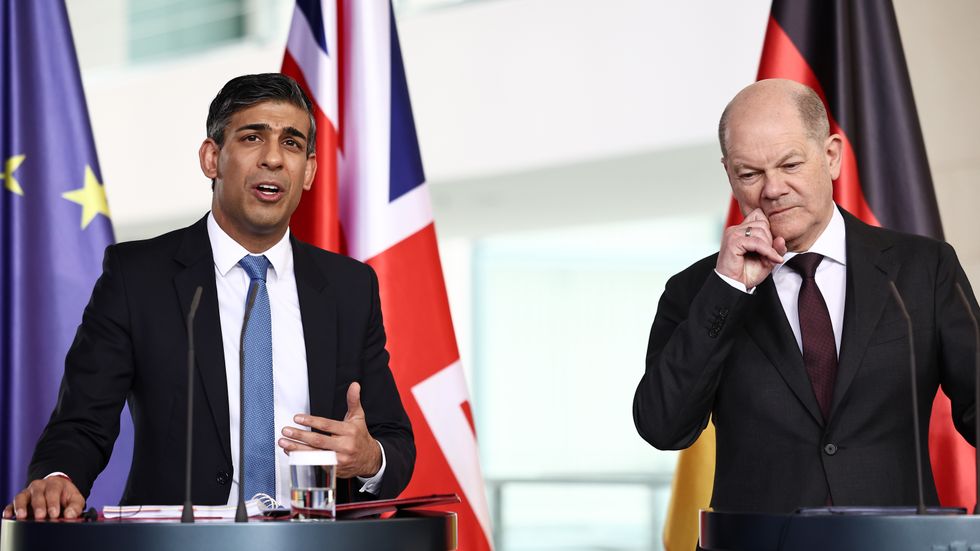
The words of Prime Minister Rishi Sunak this afternoon in Berlin, standing next to German Chancellor Olaf Scholz.
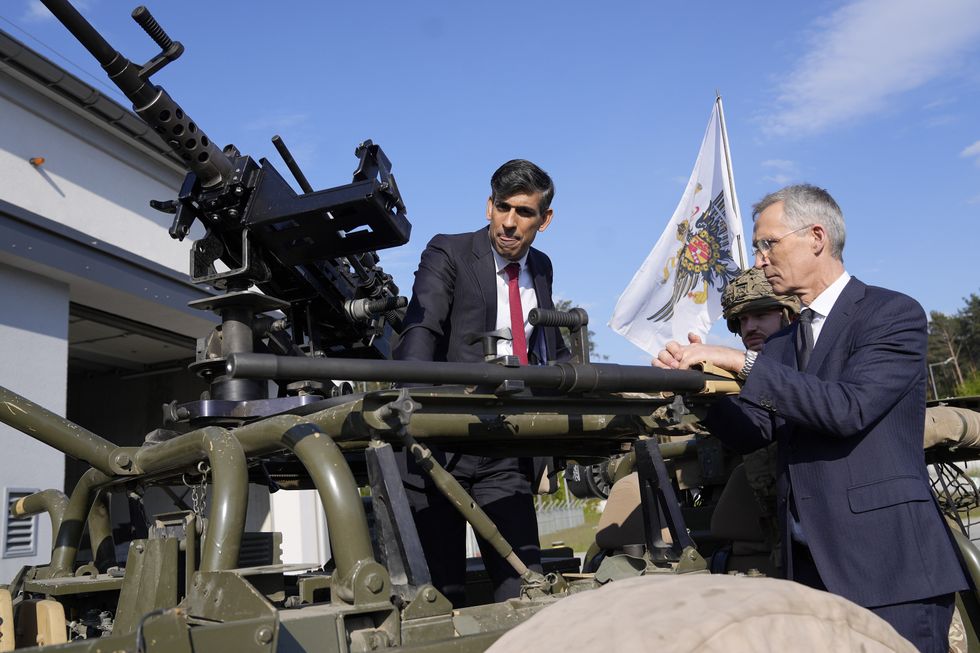
Today Berlin and Scholz. Yesterday Poland, the NATO Secretary General Jens Stoltenberg and Polish PM Donald Tusk.
But the same central message: “The world is at a more dangerous point than at any point since the end of the Cold War”. Today Sunak said we are at “an inflexion point”.

So big announcements. Yesterday’s pledge to increase UK defence spending to 2.5 per cent of GDP by 2030.
A show of solidarity with the head of Nato at a military base near Warsaw.
Today, a defence agreement with Germany to collaborate on artillery systems.
The Prime Minister says it will bring hundreds of jobs to the UK.
- Rishi Sunak pins his future on a triple policy splurge to wrongfoot Labour - analysis by Christopher Hope
- Britons will be able to use NHS algorithm to sign themselves off sick
- Sunak puts UK on 'war footing' as he announces HUGE increase in defence spending
And, following his meetings this morning with German business leaders, an announcement of £8billion in investment by German businesses into the UK.
Sunak says he is putting UK defence “on a war footing”. Our defence industry already supports 1 in 70 UK jobs.
More funding and more money funnelled into research and development can only benefit our economy.
And the Prime Minister urges other countries to step up.
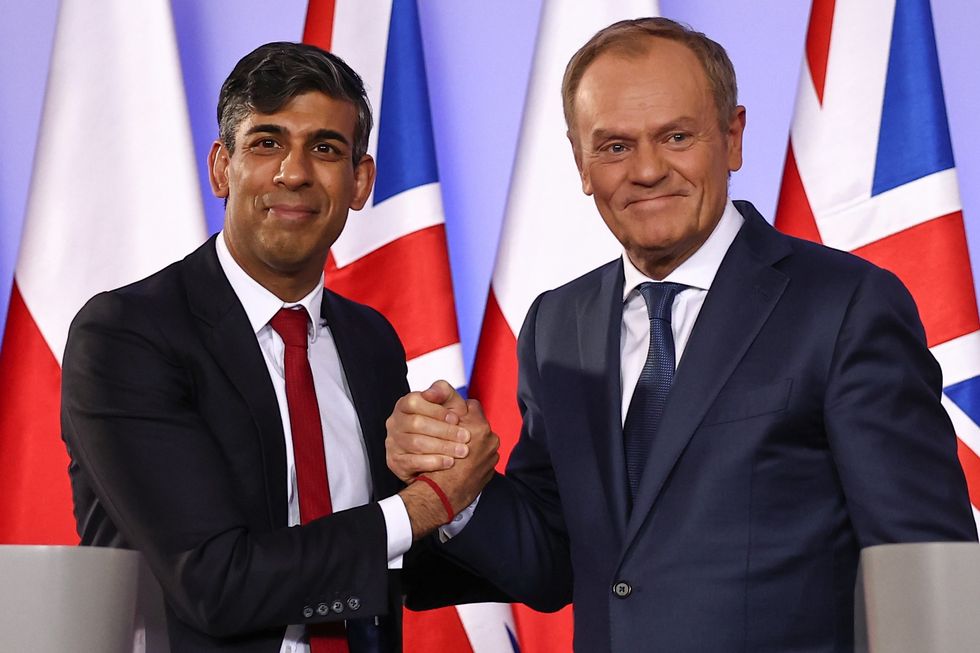
He stressed that the UK and Germany are the leading defence spenders in Europe, and the largest military supporters of Ukraine.
Yesterday’s announcement of an extra £500 million for Ukraine takes the total in UK military and humanitarian aid to £12billion.
Only 11 NATO members currently spend the supposed minimum of two per cent national income on defence.
In raising UK spending from the current 2.3 per cent to 2.5 per cent, Sunak is setting an example he wants others to follow.
But of course this is expensive. The Government claims the extra £75 billion will not be funded by increased borrowing or debt.
It talks of using money saved from cutting 70,000 civil service jobs.
The Institute For Fiscal Studies though, suggests cuts to public services will be needed. Or possible tax cuts axed.
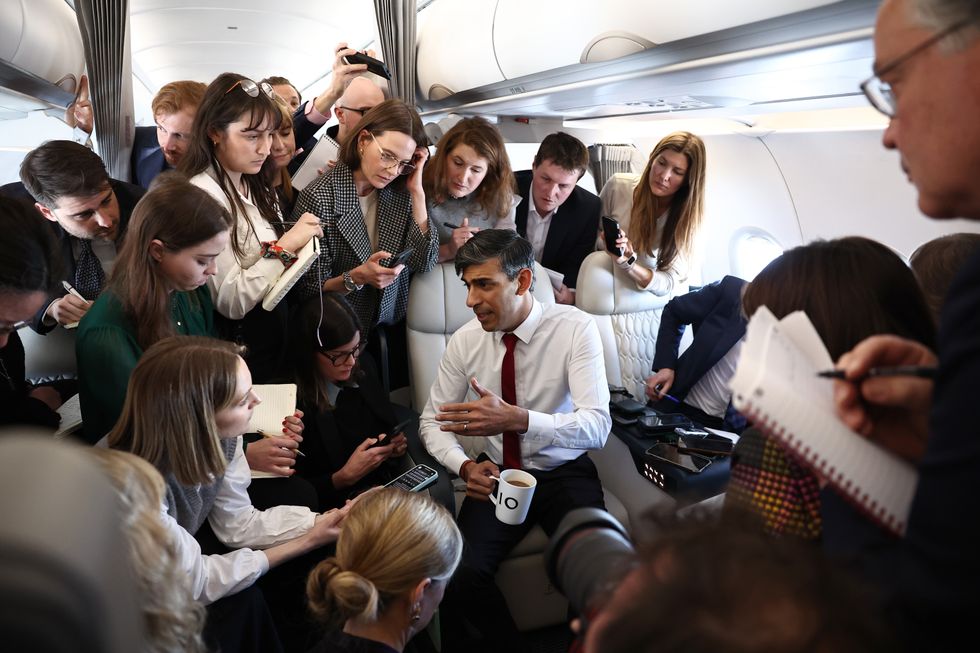
The Prime Minister was upbeat on the plane. He told us it’s a choice he believes is right, and it’s taken time to get to this point.
It won’t be universally popular. But it’s popular with his party and likely to be so with many voters too. And it’s given the Conservatives another useful dividing line with Labour.
Labour have said they’d like to get spending to 2.5 per cent when circumstances allow. And pledged to hold a defence and security review if they come to power.
And of course they likely will do, unless the polls shift massively. So, difficult choices for them.
Ultimately though, Sunak and Jens Stoltenberg stress that defence spending is largely to prevent war. A message is being sent too, to autocratic regimes in Russia, Iran, China and North Korea.
For so long the West has enjoyed a peace dividend. Those days are gone. But as Stoltenberg said: “Nato exists to prevent war.” The price of safety in a dangerous world seems to be billions more for defence. Sunak response is “so be it”.
from GB News https://ift.tt/blMchV7
WATCH: Liam Halligan opens up about his friendship with politician, Frank Field
GB News reporter Liam Halligan opened up about his friend Frank Field after it was revealed that the former MP passed away.
Speaking on GB News Halligan said: "We became friends and I was drawn to him because he was a man of principle. He was somebody very much of Labour values.
"He set up the Child Poverty Action Group. He set up the low-pay unit for really important institutions in this country. But he didn't always believe in left-wing roots to achieve those Labour outcomes, more help for the poor.
"So when it came to benefits, you can sum up Frank Field's attitude in a phrase that he coined, but which many others have since used 'Give people a hand up, not a handout.'"
Lord Field spent 40 years as MP for Birkenhead and was a leading voice on welfare reform for much of his career.
He was a minister under Tony Blair and joined the House of Lords in 2020.
WATCH THE CLIP ABOVE FOR MORE
from GB News https://ift.tt/sdcVXW8
Sunak will take the defence wins in Europe - but returns to tricky local elections for the Tories
This was a trip with two aims: to refocus the world's attention on Ukraine and announce a big boost in defence spending - with an eye, of course, on national security, but also on the general election.
from Political News - International and UK Politics | Sky News https://ift.tt/qHZyhF1
from Political News - International and UK Politics | Sky News https://ift.tt/qHZyhF1
Tuesday, April 23, 2024
Company who funded First Minister’s leadership campaign granted £400,000 Welsh Gov loan
More questions are being asked over Vaughan Gething’s judgement, as recent Companies House records show that ‘Dauson Environmental Group’ received a £400,000 loan from the Development Bank of Wales (DBW).
The loan was acquired whilst Gething served as Welsh Economy Minister and granted on the basis of building a solar farm.
Atlantic Recycling, which is connected to Dauson Environmental Group and controlled by David Neal, donated £200,000 to Gething’s leadership campaign earlier this year.
The DBW is owned and used by the Welsh Government to provide economic support to businesses.
Neal Soil Suppliers, a subsidiary of the Dauson Environmental Group, acquired the £400,000 loan whilst Gething was Economy Minister, a role which has the DBW under its portfolio.
In a letter addressing the current Economy Minister Jeremy Miles, Shadow Minister Samuel Kurtz MS questioned whether "companies run by David Neal needed to borrow £400,000, if they were in a position to donate 200,000 to Vaughan Gething - who was the Minister responsible for the Development Bank of Wales, at the time".
Kurtz added: ‘‘Given that the Welsh Government owns 100 per cent of the shares of DBW, this calls into question the independence of their financing decisions, the use of public funds and the influence of the then-Economy Minister."
LATEST DEVELOPMENTS:- 'How did we come to have this great devotion to a particular Roman saint?'
- 'Why would we trust Starmer on Brexit?!' Carole Malone hits out
- Britons will be able to use NHS algorithm to sign themselves off sick
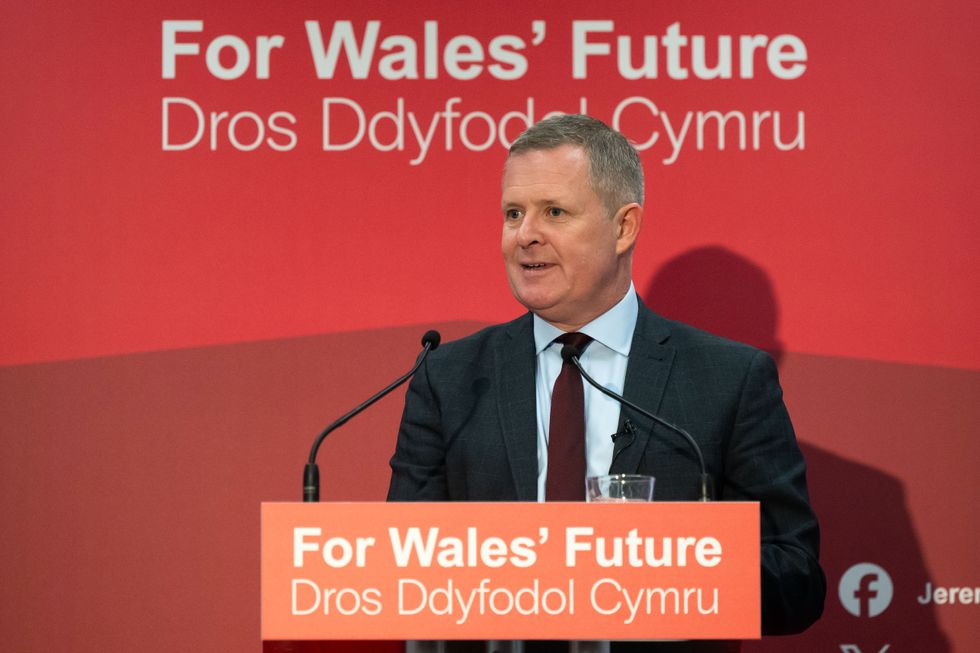
Miles has not commented on the £400,000 grant yet.
However, Miles was questioned on Sunday regarding the £200,000 donation made to Gething’s leadership campaign, Miles who was Gething’s leadership opponent, admitted he would not have accepted the donation.
Plaid Cymru said the revelations show a serious lack of judgement from Gething and "questions around transparency and proprietary just keep piling up for the First Minister".
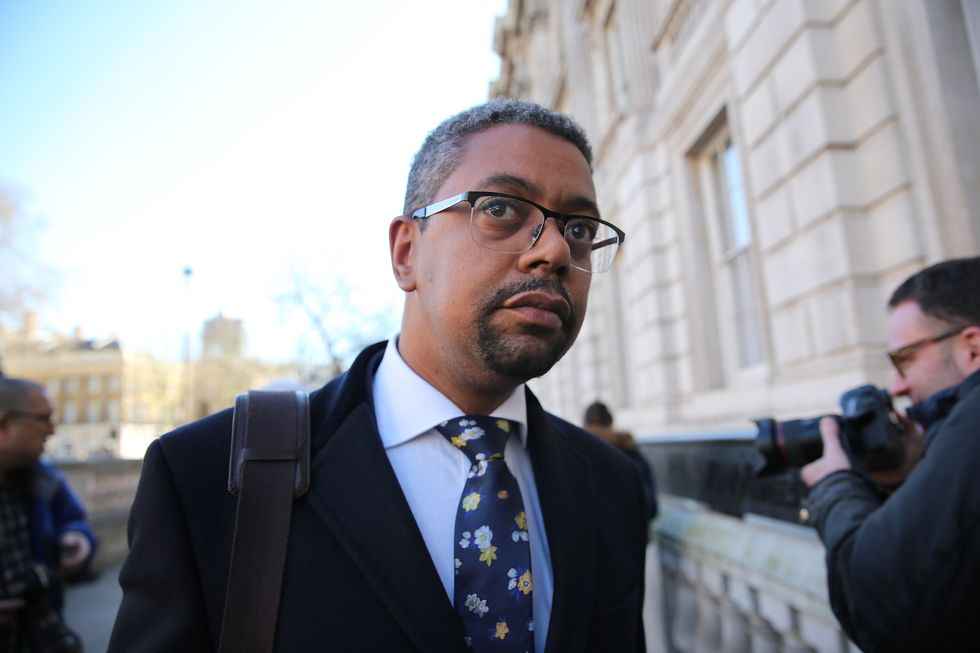
“He is seemingly being bankrolled by a man in debt to his own government – an astonishing state of affairs that is undermining Welsh democracy," the nationalist party added.
“The First Minister must make an urgent statement on the floor of the Senedd next week.
GB News has approached the Welsh Government for comment.
from GB News https://ift.tt/atkG0H3
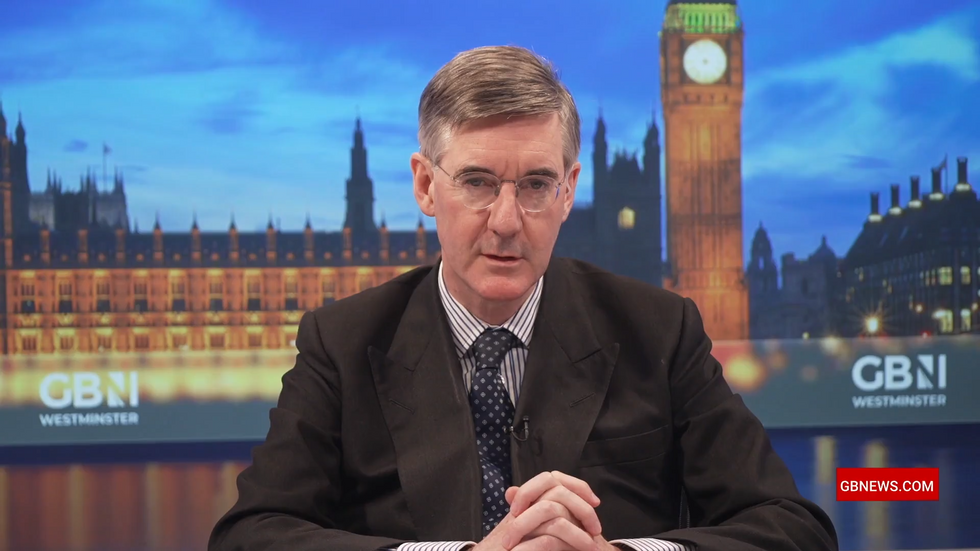
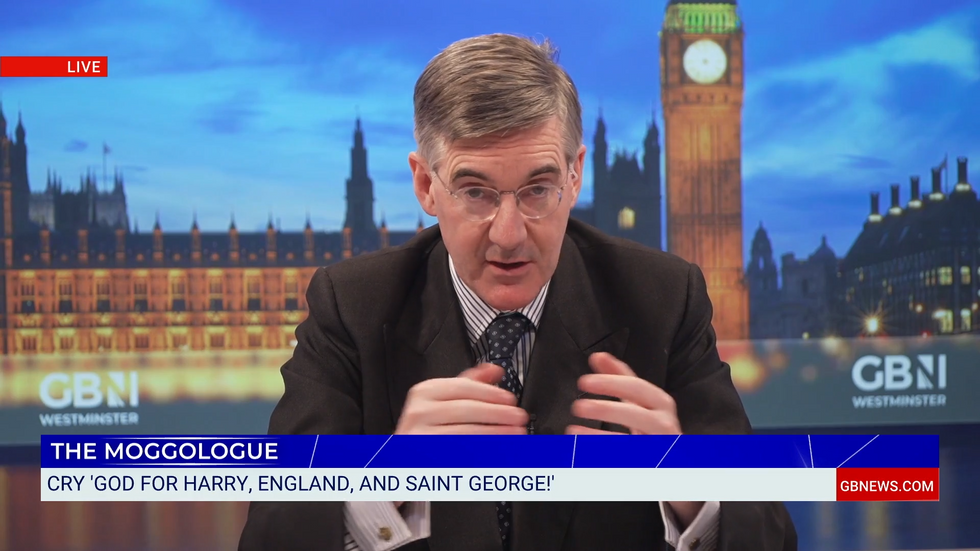
'How did we come to have this great devotion to a particular Roman saint?' Jacob Rees-Mogg
You know, the great Shakespearean shout, Cry 'God for Harry, England, and Saint George. But why Saint George? How did we come to have this great devotion to a particular Roman saint?
Well, the reason is medieval devotion. In the medieval period, people had a personal relationship with their saints.
They felt that they were intervening in their daily life day by day as a regular occurrence.
And if they were let down by their saint if they prayed, they asked for the intercession of a saint, and the saint didn't oblige. They would get quite cross.
So people had treasured relics of saints, and if their prayers weren't answered, there were reports of them throwing them on the floor and stamping on them because they were cross like a toddler with a saint who hadn't obliged.
Saint George becomes the patron of England because he's seen or was seen to have delivered. Some people believe that William the Conqueror had the banner of Saint George when he came over at the Battle of Hastings in 1066, but he was certainly thought to be present early in the Crusades.
At the Battle of Antioch in 1098 and in Jerusalem in 1099, Saint George was there urging on and indeed rescuing the English, or indeed the Norman forces.
The inspiration of the saints is crucially important, and the invocation carries on.
Even in the First World War, the troops thought at times, and this is 1914, Saint George was there helping them, aiding them, inspiring them, and boosting morale. But it wasn't always going to be Saint George. Saint George wasn't the first patron saint of England before him.
It was Saint Edmund the Martyr, a ninth-century East Anglian, a saint who was killed by the Vikings, and Saint Edward the Confessor, who competed for this important role, and it was King Edward III who decided that it would be Saint George because he established his chivalric order, the order of the Garter, which even to this day, to this year, makes announcements of new appointments on Saint George's Day, is still dedicated to Saint George.
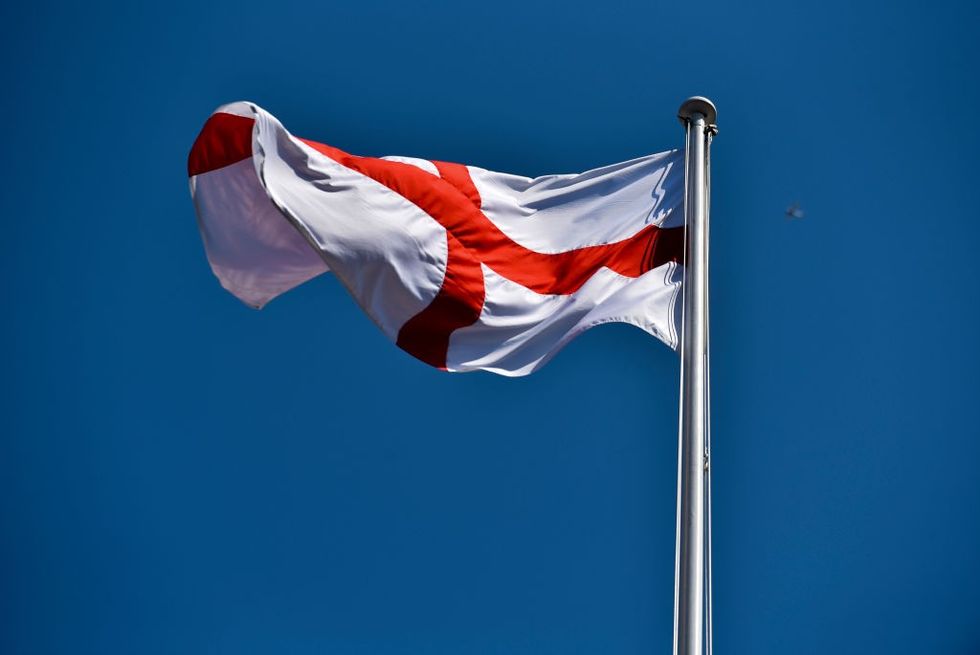
The King is still head of the Knights of the Garter, and Edward III set that up as his chivalric order. Edward IV, and set up his great chapel at Windsor to Saint George.
Interestingly, when the Protestants came in and they got rid of these saints, they abolished the order of the saints. They kept Saint George. So, Saint George remains this extraordinary figure in our national story and our island story, but very much as an English saint.
So who was he? Well, he's thought to have been martyred in about the 300 under Diocletian. His works were recorded in a very famous book, The Golden Legend.
Legend meaning story rather than fable who was a medieval scholar.
What happened with Saint George? So, a city called Silene in Libya is terrorized by a dragon which infests a vast lake and must be fed if it is to be kept away. Note the connection of the dragon with water.
This is the essential water of life and of baptism. The dragon is the enemy of true faith, and at first, the dragon is given sheep. But these run out and the citizens resort to feeding it a man and a sheep.
And then at the King's command, they start feeding it young people, and the lot falls upon the King's daughter. And the King tries to get out of this, but the people won't have it, and his daughter is sent to feed the dragon.
But, behold, Saint George rides by.
He rescues the princess and the maiden, takes the dragon by her girdle into the city, where George slays it, refuses all honour and will not marry the daughter because he is a celibate, a holy man, and the city is saved.
The dragon is slain and they all live happily ever after. That was Saint George, and you'll be glad to know.
As with all good things, it's thought he went to Glastonbury in Somerset.
from GB News https://ift.tt/MpRxdNl
Subscribe to:
Posts (Atom)